Is Jake’s Resume Good? Strengths, Limits and Fit
Jake’s resume can be a useful starting point when you want a compact, conventional document. Its fit depends on your evidence, the application instructions and how much customization you need.
Updated · Independent template guide
Make the decision from your task, not the template’s popularity
Jake’s resume is a useful choice when you want a compact, conventional document organized around education, experience, projects and skills.
Education, projects and placements.
Recent responsibility and evidence.
Publications, teaching and a longer record.
The single-column structure gives each entry a predictable place, and this builder provides a form-editing route to a LaTeX PDF. Those are practical properties you can evaluate. They do not establish that a particular employer prefers the template or that using it increases an applicant’s interview rate.
Start by asking what file the employer requires, how much relevant experience you need to show and which editing workflow you can maintain. If the vacancy needs a concise resume and your evidence fits standard sections, the template is a sensible candidate.
If the employer requires an institutional form, an academic CV or another specific structure, follow that requirement.
Where it works well for a student or recent graduate
A student can use the education entry to make the current program and expected completion date clear, then show projects or placements as practical evidence.
The structure is especially easy to understand when you have a small number of relevant items. A completed project with a specific contribution can sit beside an internship without requiring a decorative timeline or a large introductory biography.
The risk is copying the sample’s content balance without considering your own experience. If you have no internship, leaving a fictional employer or an empty Experience heading makes the document worse. Replace it with truthful project, research, work or volunteering evidence as appropriate.
Likewise, a graduate should update expected status to completed status when accurate. The template supports a clear student document, but the value comes from choosing the right facts and keeping their status current rather than preserving the sample’s exact arrangement.
Compare the five fictional student and professional examples before choosing a starting point.
Where an experienced applicant should change the emphasis
An applicant with substantial recent experience may need less education detail and more space for work ownership, scope and results.
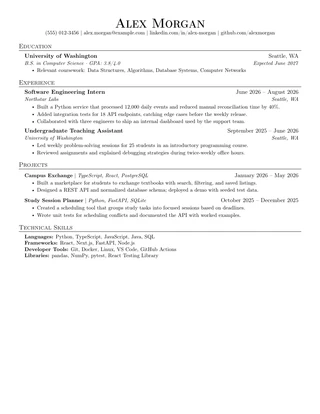 Open full PDF
Software Engineering InternNorthstar LabsJune 2026 – August 2026Built a Python service that processed 12,000 daily events and reduced manual reconciliation time by 40%.
- Clear role
- Who did the work and in what setting?
- Useful detail
- What contribution can the applicant explain?
Keep the conventional entries, but shorten coursework and older projects that no longer add evidence. A resume should help a reader understand your current level rather than continue to look like the version you used for your first internship.
One page is not an absolute requirement for every career. If relevant experience cannot fit without removing useful context or making text uncomfortable to read, consider a deliberate longer document when the application permits it.
Conversely, a second page created by two weak bullets is a reason to edit. Make the decision from content value and the vacancy’s instructions, then check the actual PDF.
Recognize cases where another structure is appropriate
A research CV with publications, teaching, grants and a long academic record needs a different amount of detail from a compact employment resume.
An employer-mandated form should be completed in its requested structure. A portfolio-led application may need a separate portfolio alongside a straightforward resume rather than a heavily decorated resume standing in for it. These are examples of different document tasks.
Editing preferences matter as well. If a collaborator must use a word processor, an editable Word workflow may be more convenient than source editing. This site can export a DOCX, but it should be reviewed independently because it is not the LaTeX rendering.
If you need unsupported TeX layout changes, source portability may be useful, with the responsibility to compile and check the modified project. Choose the workflow you can actually maintain instead of choosing a template solely because its preview looks familiar.
Judge your draft on evidence, reading order and file quality
Evaluate the draft at three levels.
- 1One qualification
State the actual degree and status.
- 2One strong entry
Describe relevant work or a project.
- 3One reviewed PDF
Check readability and whether the structure fits.
First, ask whether the content supports the role: can a reader identify your level, relevant capabilities and strongest examples? Second, inspect the reading structure: are headings recognizable, dates associated with the correct entries and bullets easy to follow?
Third, inspect the final file: does it open, contain selectable text and meet the requested format? A template can help with structure, but it cannot supply missing evidence or verify that your statements are accurate.
Avoid replacing these checks with a universal ATS score or a claim that one visual style is preferred by every recruiter. You can test text extraction and inspect a particular application’s parsed fields where available. You cannot infer a hiring decision from a clean extraction result.
Use the specific checks in is Jake’s resume ATS friendly? for the final attachment.
Try a small version before committing to the layout
The quickest useful test is to enter your real contact details, one education item and your strongest experience or project.
Compile that small draft and inspect the final PDF at normal zoom. Check whether the entry structure suits your text, whether the chosen font is comfortable and whether you understand how to maintain the document. You can do this without an account for ordinary editing and exports.
If the small draft works, add the remaining relevant evidence and save a structured backup. If it does not, identify the actual problem: unsupported layout, an unusual document requirement, an editing preference or content that needs a different organization. The comparison guide can help distinguish these cases.
For specific layout and workflow tradeoffs, read Jake’s resume alternatives.
Diagnose a weak draft before deciding that the template is wrong
A thin-looking page can have several causes.
You may have selected too little relevant evidence, described useful work too vaguely or left the sample’s section order unchanged when another order would help. Try explaining one project through its problem, contribution and validation before changing the layout.
If that creates a clearer account, the issue was content selection rather than the template. Conversely, if a required qualification or document section cannot be represented clearly in the supported structure, that is a genuine reason to consider another document format.
Where the format has limits
| Need | Jake’s layout can help | What to check |
|---|---|---|
| Conventional technical resume | Clear sections and source-based PDF | Relevance and readable density |
| Extensive career history | Reorderable work entries | Whether a longer document is warranted |
| Visual portfolio | A concise background summary | Separate work samples and portfolio |
| Employer-mandated file | PDF or editable DOCX export | The exact application instructions |
Make the decision with your own material
- The format fits the application instructions.
- The strongest evidence is easy to locate.
- No important content is hidden by excessive compression.
- The exported file looks and reads as intended.
Questions about this guide
Is this the official Jake’s resume website?
No. This is an independent editor based on the MIT-licensed template. It is not affiliated with Jake Gutierrez or Overleaf.
Does this format guarantee interviews?
No. This page evaluates layout and workflow tradeoffs. It does not claim hiring outcomes, employer endorsement or universal ATS acceptance.